

singularity practice almanac
premise
If prediction is the basis of intelligence, then this almanac is a prediction on new modes of working.
In the 30 August 2026 DigitalFUTURES broadcast, Neil Leach spoke about the death of architecture in light of rapid advances toward artificial superintelligence.
In response to Leach, on my broadcast on the same channel, I predicted three modes of surviving practice: how architects have a second life.
They are: conventional practice, showing the pyramid org chart; extended mind practice, one human thinking through a rig of tools; and decentered practice, where the human steps to the edge.
My own practice runs all three concurrently.
ai takeover
loop: work completed by repeating a process
We are witnessing all meaningful work taken over by AI.
Shown here is the human relation to each field: the closer the human is to the loop, the decision-making process, the closer the human involvement. The diagram is organized by the speed to complete the loop.
In finance, AI takes everything in microseconds; humans are already out of the loop. Self-driving cars have humans at the fallback position, and so on. Architecture is not so neat, but AI is taking over everything.
attended ai loop
human in the loop
The attended loop is how most architects and professionals are used to interacting with AI: one human, one model, in a serial conversation or prompting. This is like chatting with ChatGPT or Claude in a chat interface, or queuing up Midjourney.
agentic ai loop
the loop runs without human
The agentic AI loop is the forward way of interacting with AI. The architect, the operator, briefs the agent; the AI has become so capable that it now holds goals and can plan on its own. The human waits at the checkpoint while the AI works on its own.
conventional practice
pre-ai · every task has a human attached to it
How does the AI takeover, and the new ways of interacting with AI such as agentic, affect our practices? I argue three modes will survive, leaner and stronger.
The first is conventional practice. This is the org chart we are all accustomed to: a top-down hierarchy with a human attached to every position. The current default.
Peter Zumthor is not going out of business because AI is here. Architects will still have various modes of operation, is what I predict.
extended mind practice
This is where I am primarily occupied these days. A new mode of practice has emerged in which one human is amplified by conventional and novel means of AI collaboration. This is the extended mind practice, based on Andy Clark and David Chalmers's argument that the mind extends into its tools, which Neil Leach opened my mind to.
The inner layer is conventional tools, the middle layer generative AI, the outer layer agentic AI. The agentic AI can use the tools of the inner layers as sub-agents.
decentered practice
humans supervise to sign and seal
The way forward will see a further displacement of humans from the work itself. In decentered practice, agentic AI and its sub-agents can run an entire practice and organization, including most design work. Agentic AI takes care of most coordination and work; the human steps to the edge.
This mode of working is going to exist along with the other modes, is what I predict. This presentation was made in part using this method; the steps follow in the third case study.
caltech cast
center for autonomous systems and technologies · 2017
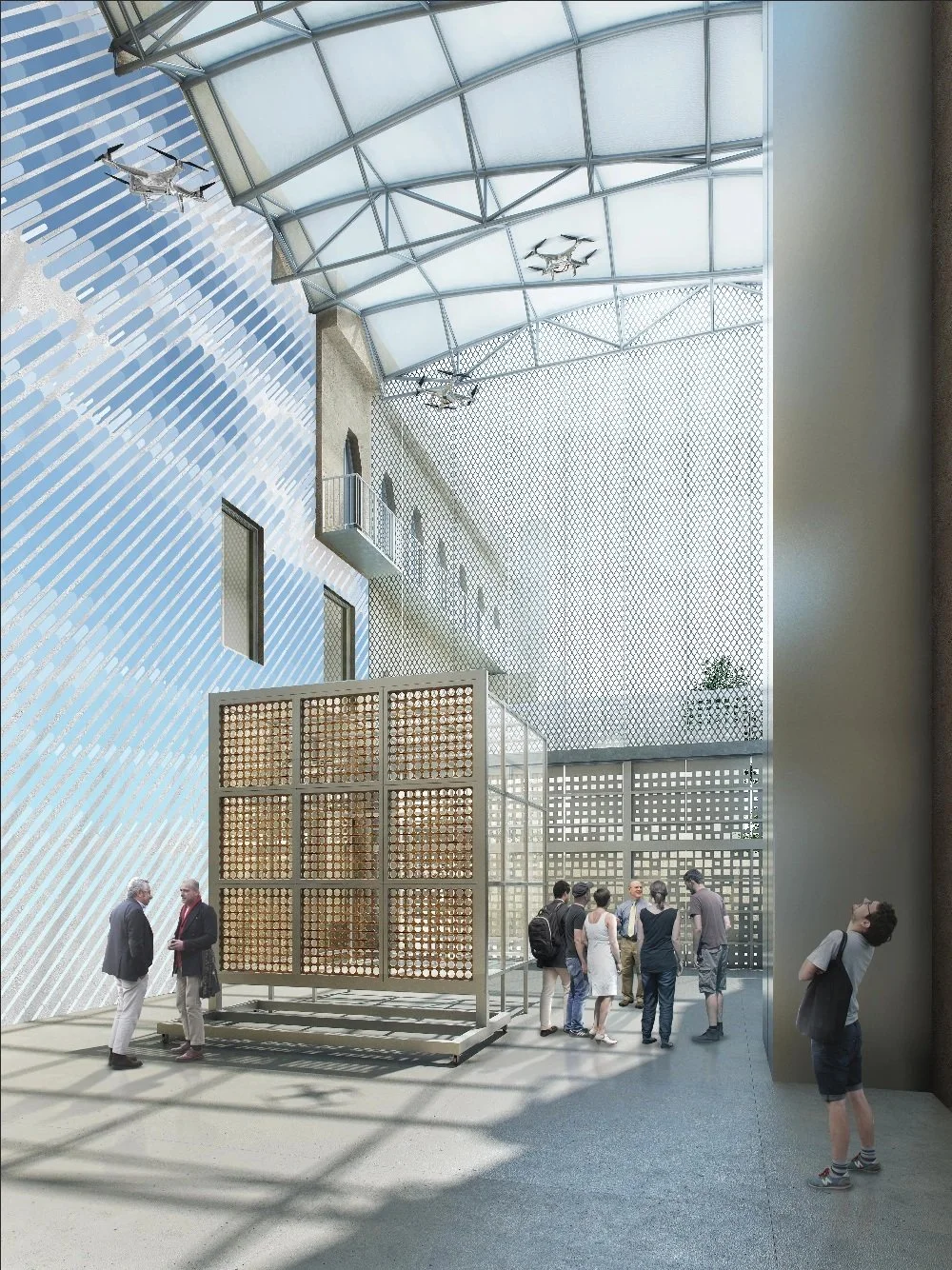
Caltech CAST was completed in 2017 as a design-build project led by MATT Construction and CO Architects. I was involved from schematic to punch list as the designer and project architect, while working at CO.
It is an adaptive reuse project that converted a courtyard into a drone testing arena with a covered roof. I designed the ETFE tensile roof geometry and the arena.
This project was my first encounter with machine learning and robotics. It is an example of conventional practice, in which AI was then the client and subject matter.
ai sapien
Case study two: three recent projects made with layers of AI, in the extended mind practice that I currently run.
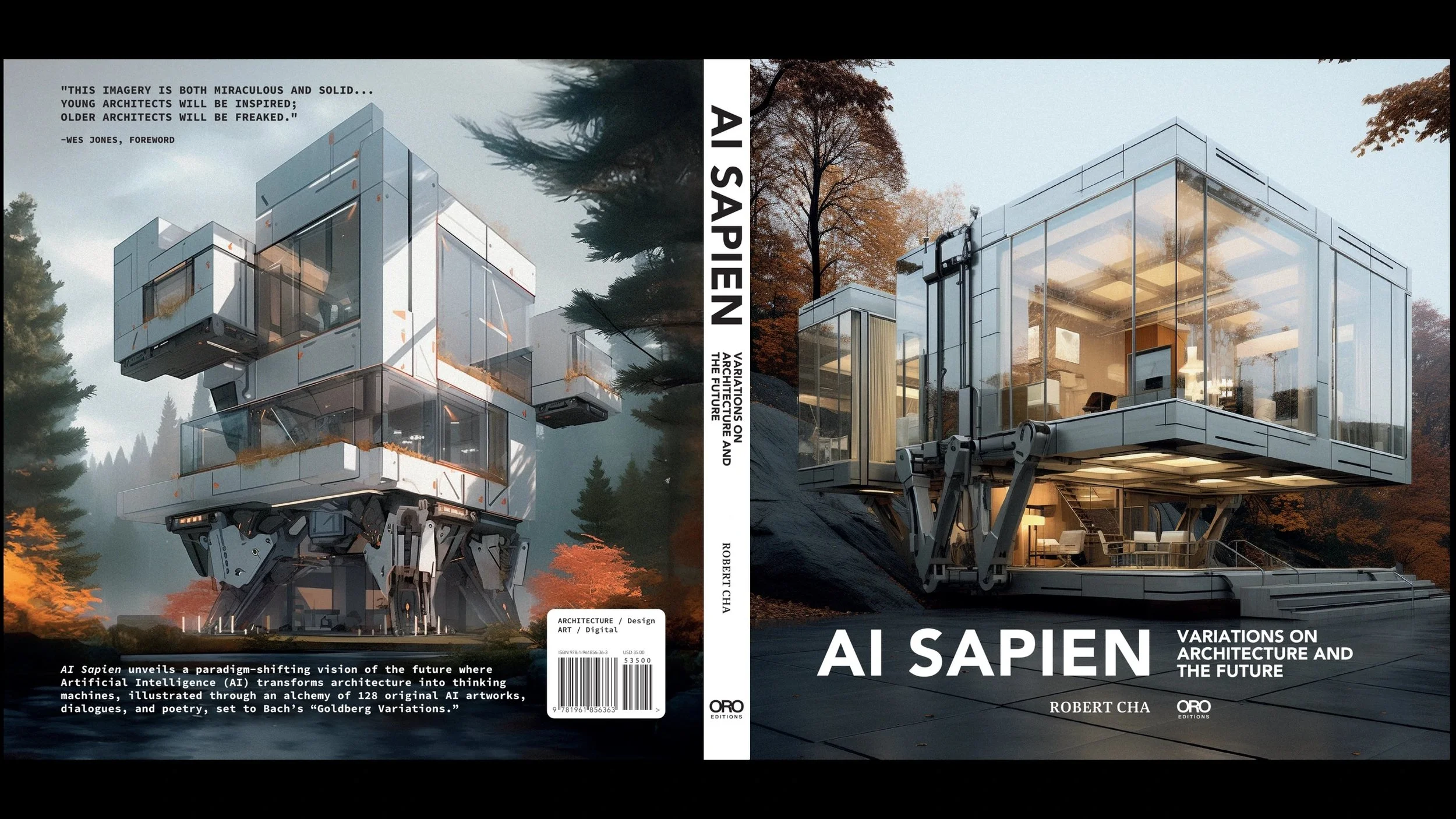
This is my 2024 book, AI SAPIEN: Variations on Architecture and the Future (ORO Editions), foreword by Wes Jones. The book contains dialogues with three AI systems, set to images made with Midjourney.
Platonic dialogues ask the AI themselves on topics of simulation and consciousness; the book is a rare creative work rather than a manual. AI SAPIEN won first place at the A+D Museum Awards in 2023 and is in sixty-plus institutional libraries, including the Getty and Princeton University.
oro editions · foreword by wes jones · first place a+d museum · wac's top 10 architecture books · 60+ libraries including the getty
ai collab: midjourney, bard, chatgpt, firefly, grammarly, claude
ai sapien portraits
These are based on lecture slides for a symposium at SCI-Arc in March, and for the Chimera issue of AD, guest edited by Elena Manferdini and Damjan Jovanović. The machinic architectures are portraits: mechanical dwellings, as sentient machine entities.
AI SAPIEN is the term described for the sentient and sapient machines: AI and robotics. The term SAPIEN is a Derrida-inspired play on words based on Homo sapiens, in which the final "s" is removed in a purposeful misspelling to indicate absence and deferral of meaning. These beings, like us, are incomplete without symbiosis.
sci-arc chimera symposium · ad journal vol 96.2 · guest edited and curated by elena manferdini and damjan jovanovic
simulacra museum
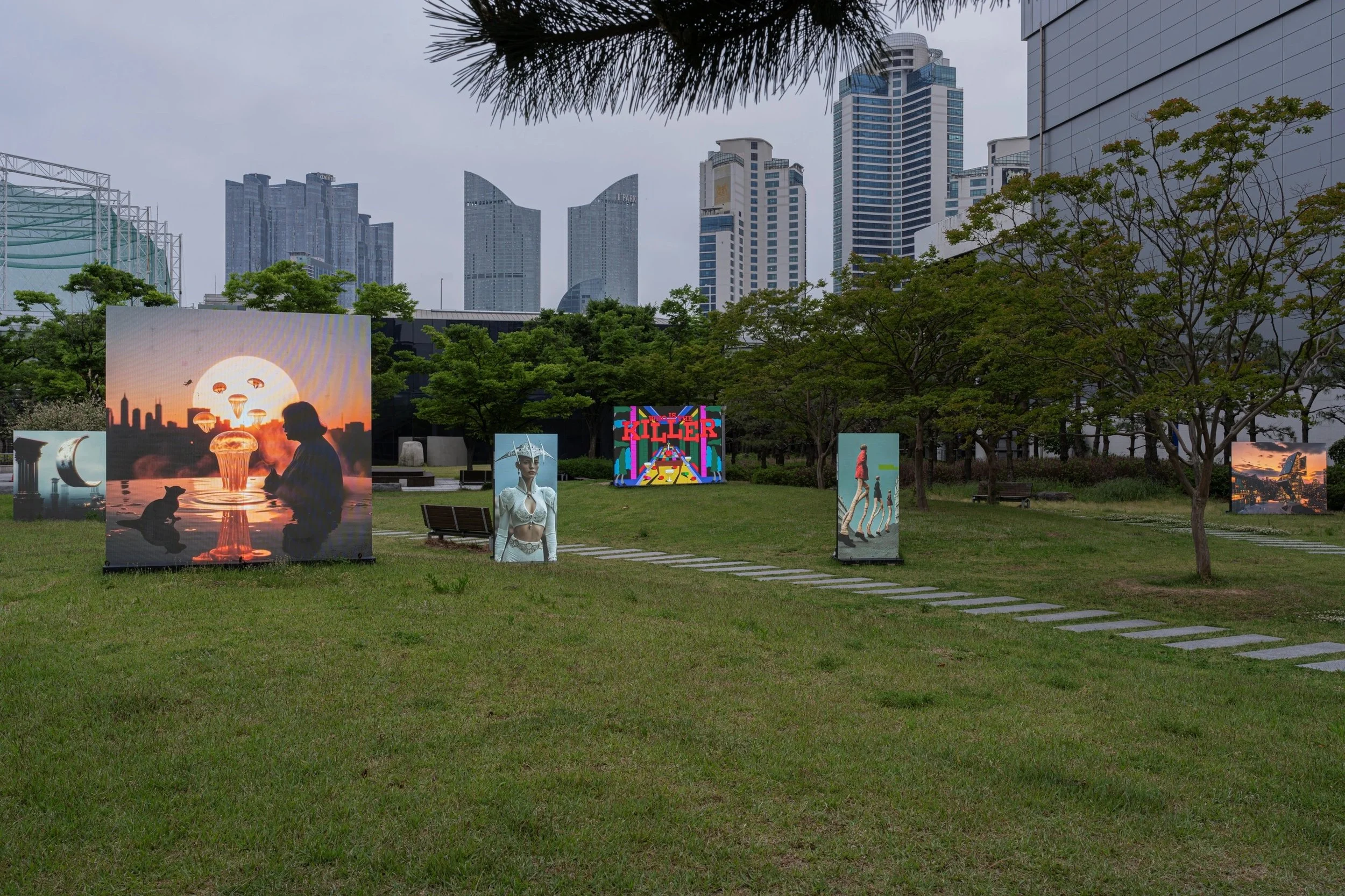
The final example of extended mind practice is the Simulacra Museum. The Busan Museum of Art commissioned the piece for an exhibition that ran in 2026. Here are the process and the steps.
design commissioned by
busan museum of art 2026
layers
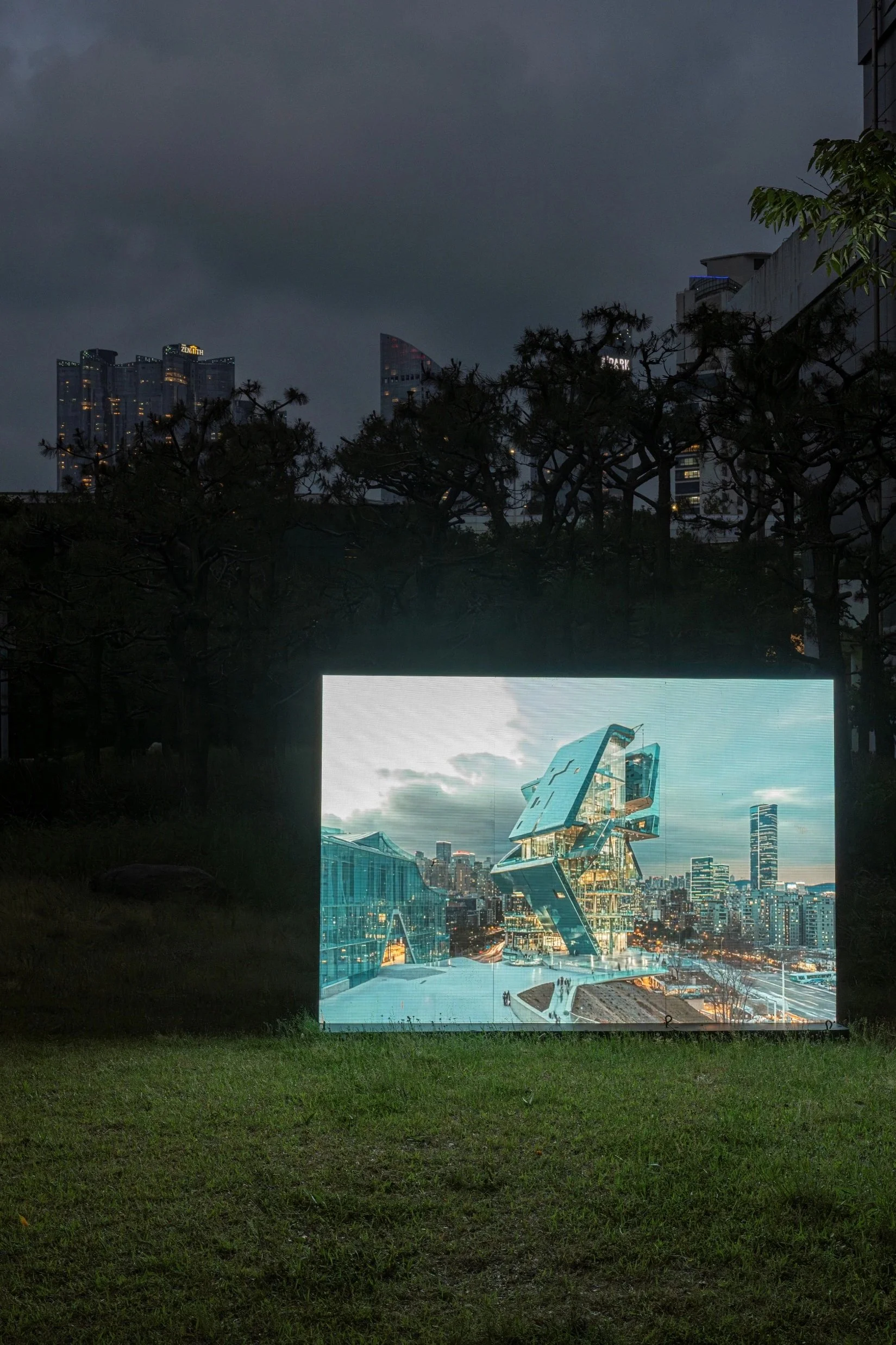
I work in layers and steps. The initial image is generated from seed images and mood boards, with the graphic rendering settings purposely lowered.
Midjourney, as with most frontier AI, has a very finite processing capability. If you want photorealism with novel form, it muddles in the middle. So form first, then texturing. The realized materiality comes in layers, to additively combine the finite computational allotment of each prompt.
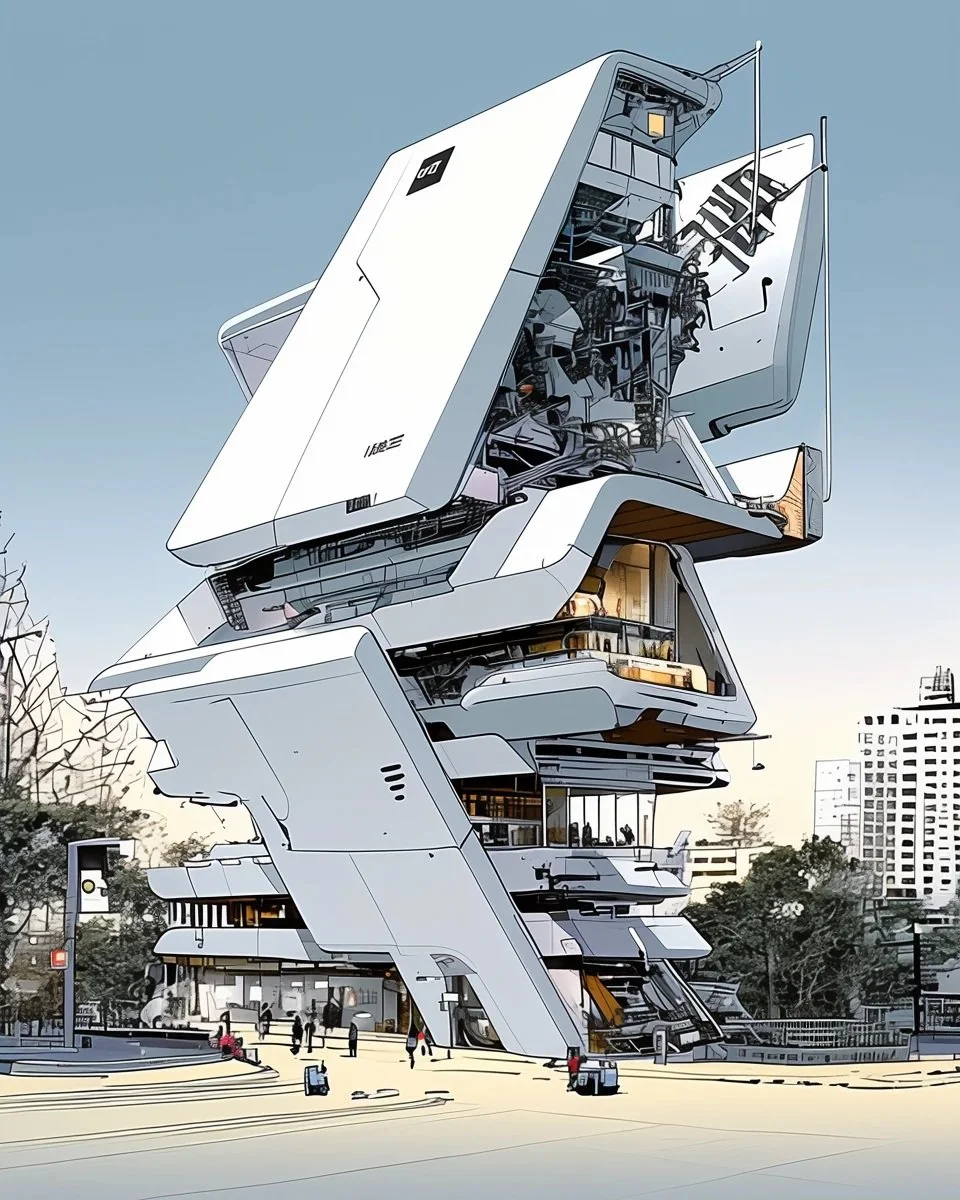
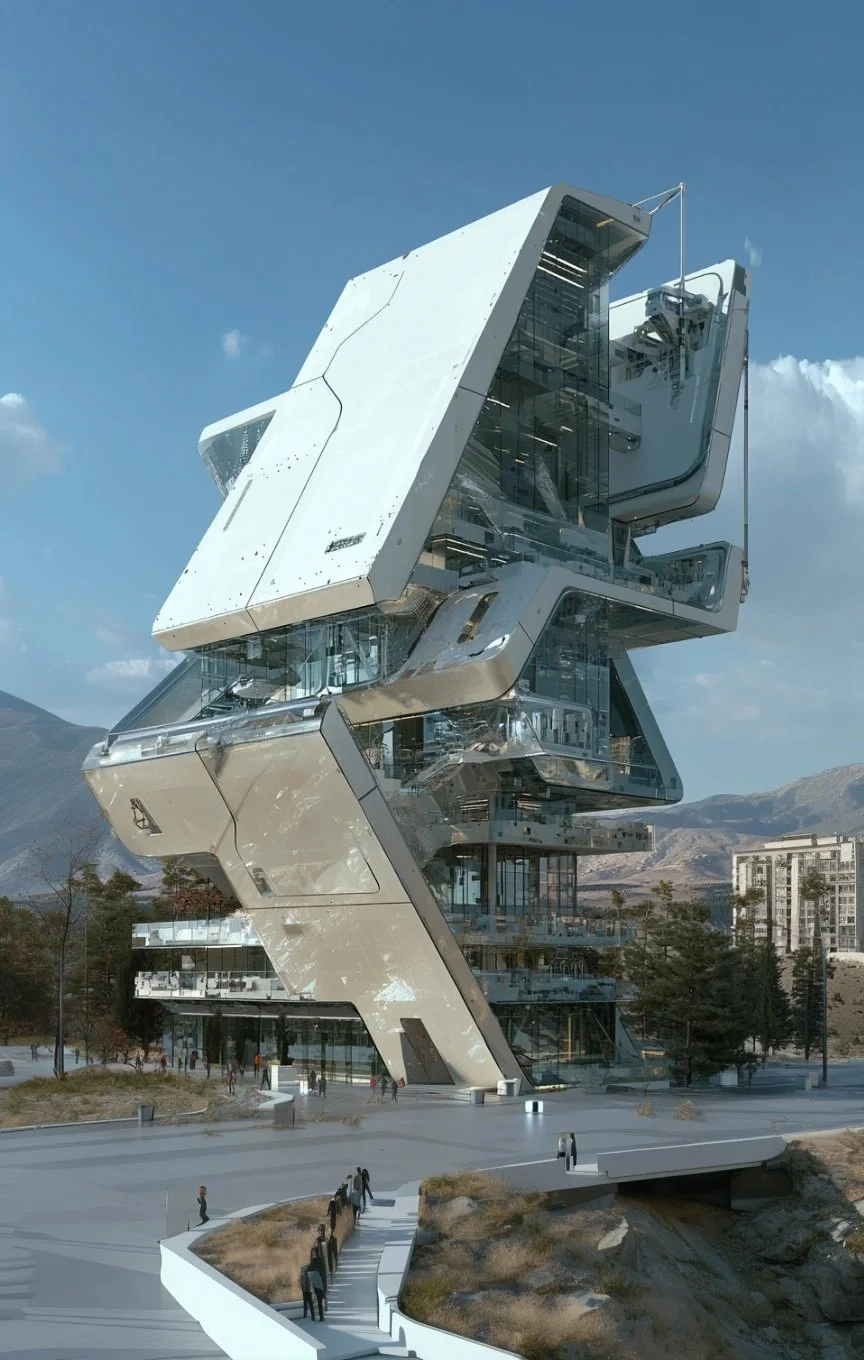
kling: animation
Curatorial text / Simulacra Museum (2026) / excerpt
... this work may be understood as a “postcard” arriving from a future yet to come, as well as a “virtual enclosure” that accommodates the digital works of fourteen artists participating in the Digital Subculture exhibition. Although its origin is entirely virtual, the image appeals sensorially through high-resolution visual bandwidth and emotional density, thereby producing a tactile sense that resonates with reality.
Referencing Alvin Toffler’s concept of “future shock,” this futurist architectural imagery also functions as a buffer against rapidly shifting technological conditions. By preemptively exposing viewers to a sense of the sublime revealed through machinic cognition, the work seeks to mitigate the dystopian anxieties experienced within a society increasingly intertwined with digital systems. In this sense, it may be understood as a form of “rehearsal” for a reality that has not yet been realized.
three-dimensional output
Diffusion-based images can be exported as three-dimensional output. Tripo exports to Rhino as geometry, in formats including FBX; the designer can orbit the image, model over it and translate it. Various competing models for direct-to-BIM are also emerging in the market.
The aerial and the wireframe, rendered by Gemini, have the hill-sited museum overlooking a virtual Busan.
digitalfutures lecture diagrams
agentic loop based delegated design · 2026
For the third and final case study, of decentered practice, the case study is this presentation you are watching right now. These diagrams were drawn by Claude agents, running the agentic loops with sub-agents in tow.
These are the parti sketches, done on paper and photographed by me as documentation. It is loose and messy; for me, idea generation still starts with pen on paper.
Then the brief, as a conversation with the agent. I describe my work model and the goal to the agent in plain language, seed it with my own diagrams as reference images, and allow the AI to make its own decisions. The plain language sets the criteria after that.
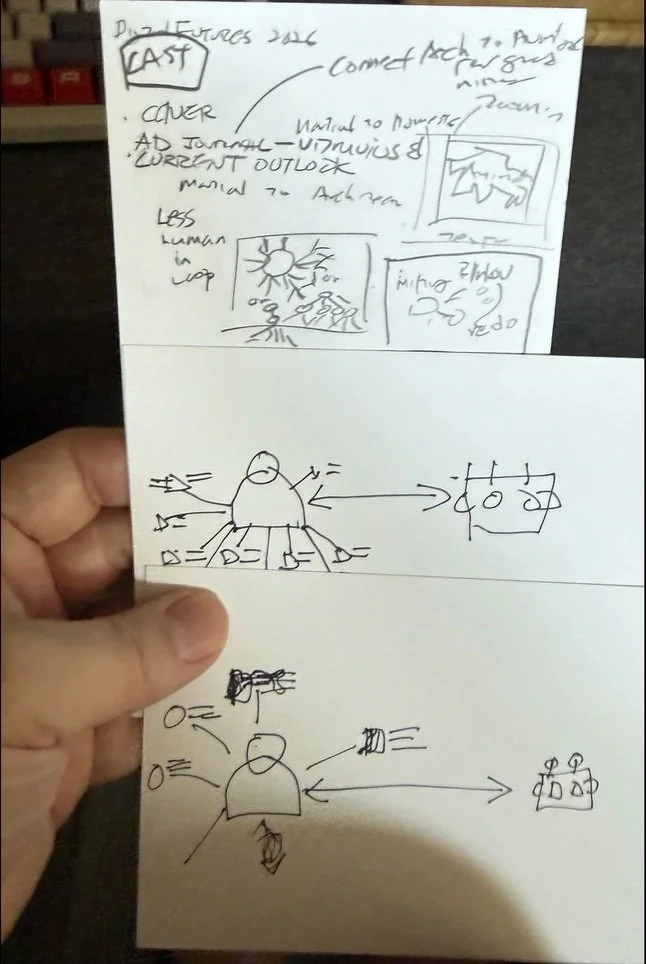
photograph by the author
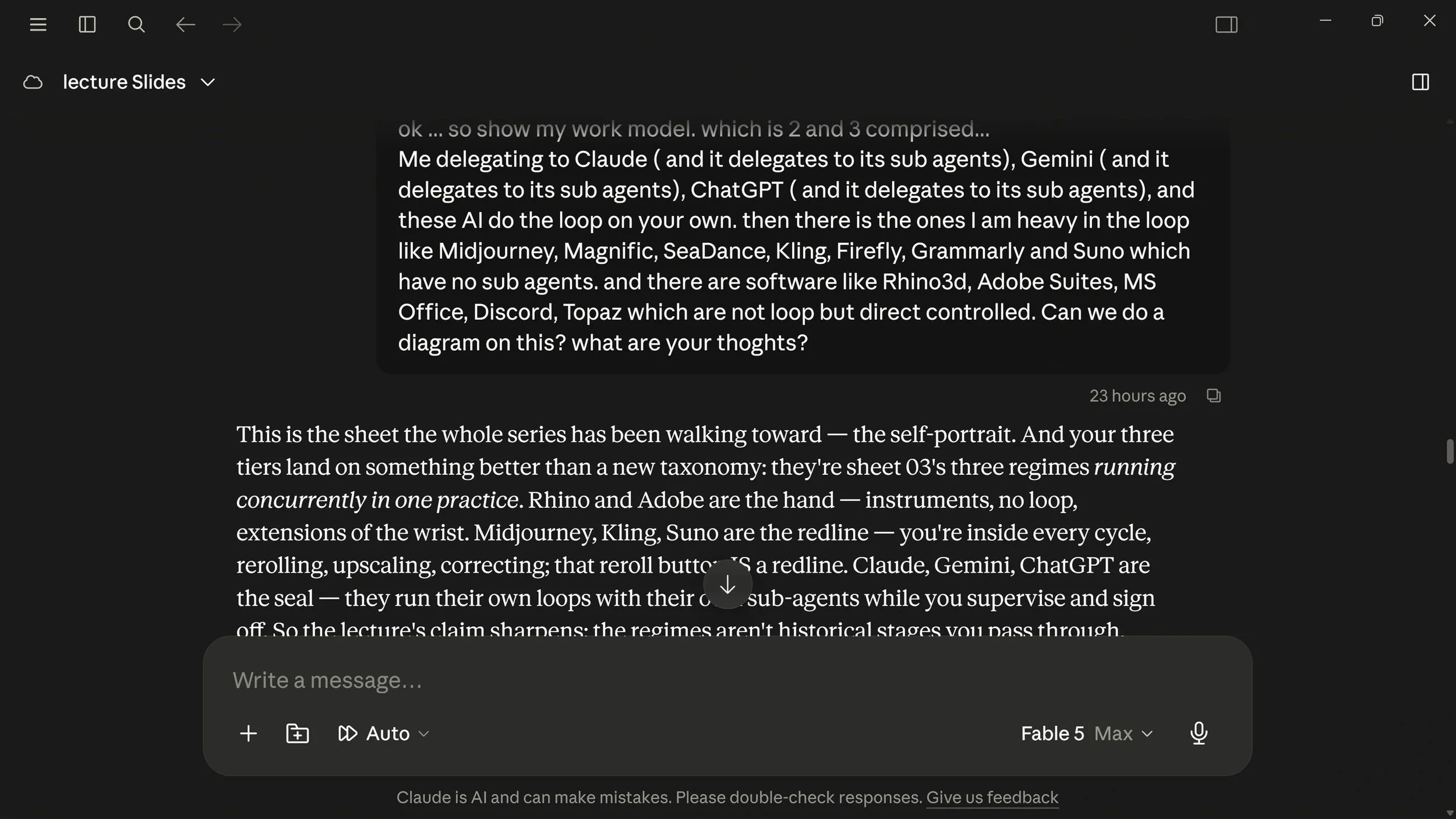
iterations
evidence of human in the loop
Then I manage by markup. The agent proposes. I redline. The AI corrects.
The agentic workflow can read markups now. On the upper right, I told Claude to align the legend to the right, and it did.
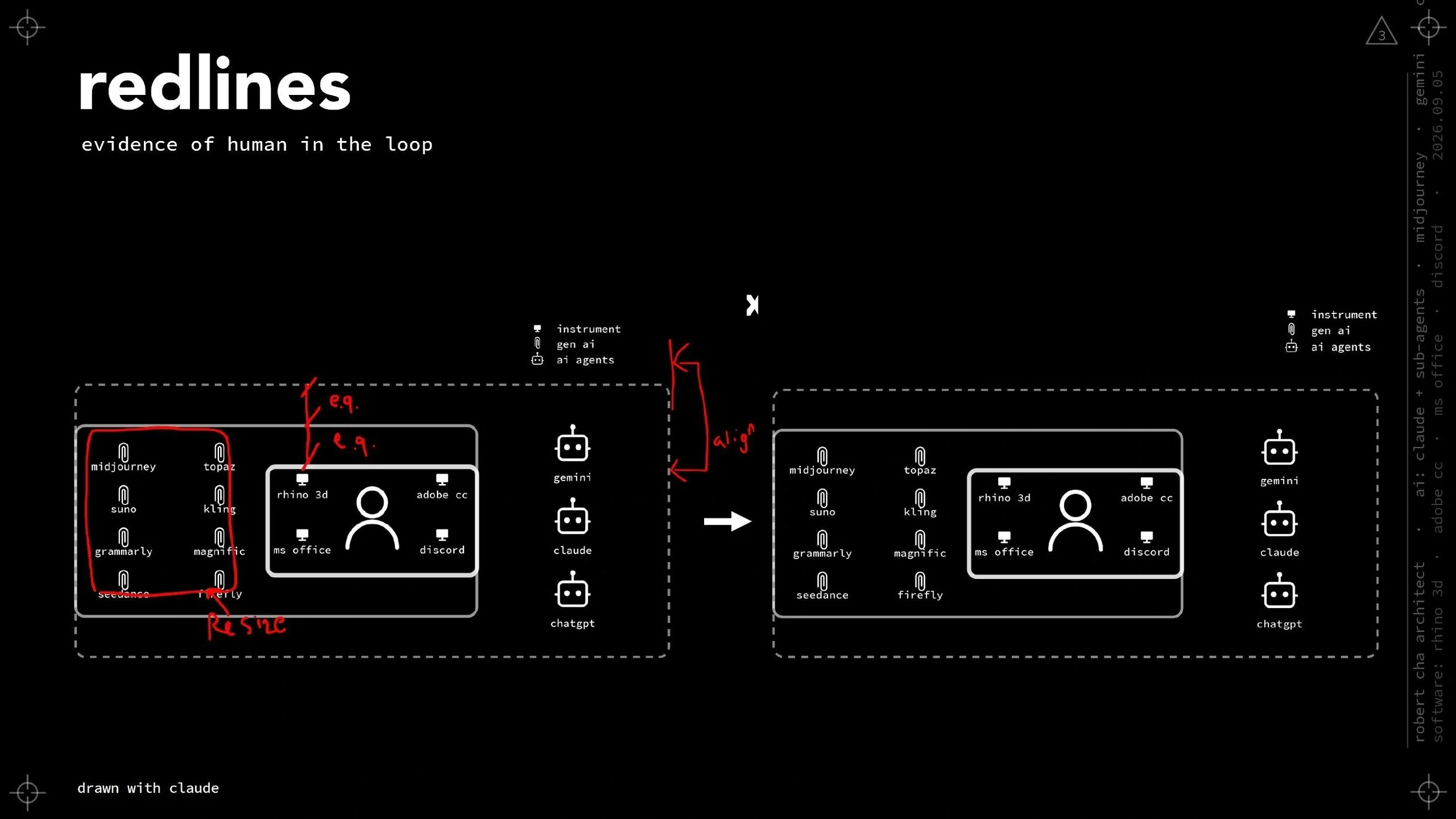
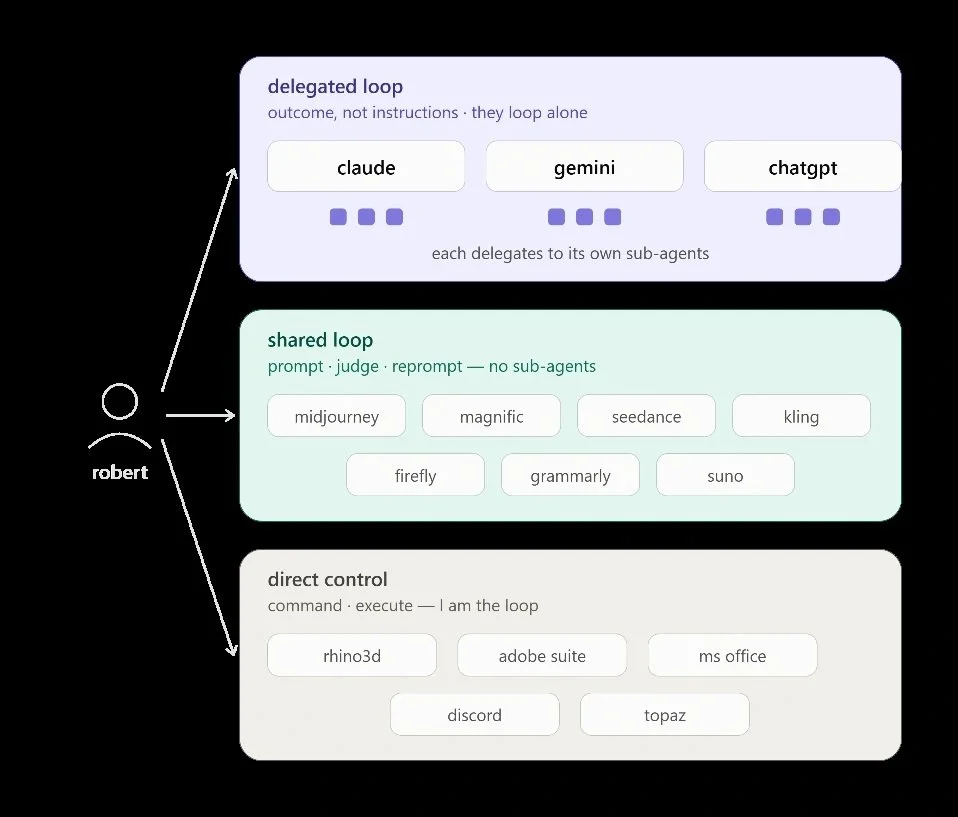
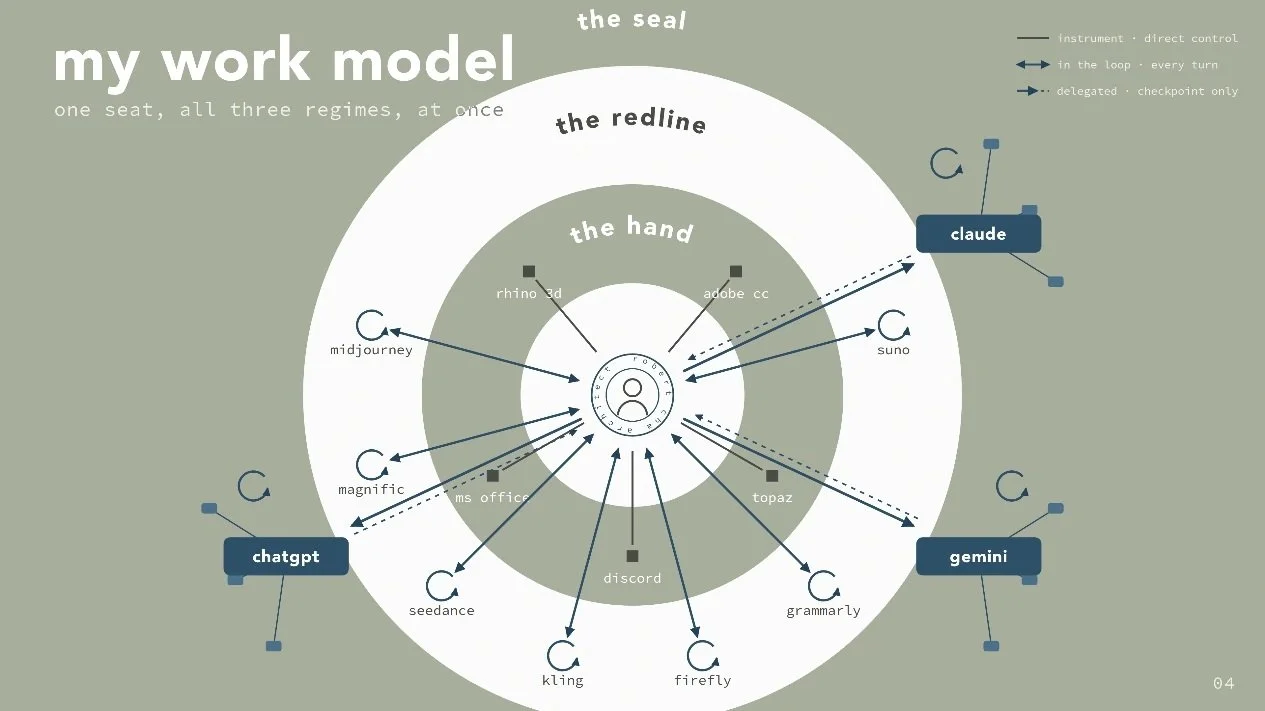
In an iterative sequence the form of the diagram is improved and made more elegant and topic-sensitive. Two initial proposals are rejected here, and one is kept. This presentation is full of such micro and macro decisions by the operator and the agents. The human operator who is more critical, able not just to curate but to guide the direction, will be successful.
crisis of authorship
Why even have a human, when superintelligence arrives? I posit that someone needs to be fired or sued. That someone is you. As long as AI does not have legal personhood, we leverage human personhood in addition to drafting skills, in the singularity.
Architects depend on our own personhood, is my argument. It is a step more cynical than curation itself.
practice predictions
In light of these three modes of surviving practice in the singularity, the almanac now concludes with predictions.
predictions: conventional practice
legal status becomes the human moat: machines cannot compete on licensure or carry liability.
more clients rely on the machines, not humans, for design: discipline shrinks and stratifies.
a simulated construction sequence
midjourney · kling
predictions: extended mind practice
the singularity is here. machines exceed humans in most capabilities.
most designs are made by machines. in a sea of sole practitioners, selection is ruthless. most become hobbyists.
machine utopia
midjourney · kling
predictions: decentered practice
the start of armageddon, or of utopia. the almanac forecasts the latter.
agents enter superintelligence. architecture schools split: sanctuaries of human craft, or incubators of decentered practice.
self portrait of midjourney
kling
are we human?
architectural mitosis
Let's project forward and run a simulation of what practice would be, from conventional practice to decentered. What we call architectural mitosis is when humans are able to field countless agents and artificial superintelligence.
The decentered discipline divides like a cell, showing the doubling of computational power available to the operator. Earth and the human remain in their central orbit at first, as superintelligence keeps increasing human potential and our civilizational reach. Practices split, spawn and multiply, until we are no longer sure if the people in them are human, or machines, or something else.
Are we human still?
Machine Rules
I never delegate the parti.
I treat the machines with care.
I sign nothing I did not judge.
Read more on AI SAPIEN: Variations on Architecture and the Future (ORO Editions, 2024)
Read more on Chimera: The Architecture of Contemporary Utopias (Architectural Design, Vol. 96.2, 2026)
Guest-edited by Elena Manferdini and Damjan Jovanovic
Colophon
- Robert Cha
- Architecture, authorship and direction
- ChatGPT-6 Astra
- Web design, editorial adaptation and implementation
- Claude Fable 5.1
- Web typography, diagram plates and repairs
- Claude Opus 5
- Diagram architecture and loop engineering
- Claude Fable 5
- Agentic AI technique and conceptual synthesis
- Claude 3
- Dialogue and concept synthesis in AI SAPIEN
- ChatGPT-3.5 & 4o
- Poetry and concept synthesis in AI SAPIEN
- LaMDA (Bard)
- Dialogue and concept synthesis in AI SAPIEN
- Gemini 3.1 Pro
- Aerial renderings and wireframe
- Midjourney
- Still imagery
- Stable Diffusion
- Still imagery
- Seedance
- Animations
- Kling
- Animations
- Magnific
- Upscaling
- Topaz
- Upscaling
- Firefly
- Generative fill
- Tripo
- 3D model extraction
- Suno
- Music
- Grammarly
- Copyedit
- Software
- In addition to AI collaboration, the author relies on software: Rhinoceros 3D, Adobe CC, MS Office, and Discord.
- Avenir 95 Black · Source Code Pro
- Original presentation typography
- Website typography
- Avenir 95 Black · title, headings, author line and Machine Rules.
Source Code Pro · the title's first word, labels and credits.
Georgia · reading text.
The two shop faces are served by this site; Georgia is a system face.
discussion
Neil Leach
So Mitra has another question. Maybe this should be directed towards Robert. We haven't had enough from Robert. I mean, I've got a question for Robert, but Mitra, do you want to ask your question?
Mitra
Yeah. I have a general question regarding the discovery in spatial patterns, because I think maybe AI is surpassing our brain's capacity for even spatial patterns recognition, either as human being or human or as a designer.
If an AI could develop a completely new spatial logic, not by imitating existing architecture, but by deriving it from environmental data, human cognitions, and et cetera, would that still be architectural design or it would be the first form of non-human architecture? Or shall we redefine architecture as a science of discovering spatial patterns? Thank you.
Robert Cha
I'm a traditionalist. I still think architecture is about space and about humans. So a lot of the discussion I'm hearing tonight is Midjourney makes these fantastic images. The spaces are very complex. How does that translate to real-world physical presence?
And I think that's the wrong question. You don't use Midjourney for real projects because you can't define site condition. You can't define code condition. You can't define budget. It's a formal generative tool, which is very valuable too, but it's not the process forward.
I'm not so sure what agentic AI Daniel Bolojan and Angelica are using, but agentic AI that I use is Claude. And Claude uses sub-agents. And what it can do right now is I can provide a sketch of space, because we're talking about human space and machine space, and have Claude model it, take it to Midjourney, variate it, and you still contain that site condition, code condition, that initial parti sketch brought in.
I think it's upon human architects who are trained in art of building and human spaces to insist that AI makes human space for human occupation to further our thriving.
Neil Leach
Maybe, I don't know, maybe I could just throw in there that, I mean, so what if the AI was basing it on human, let's say, comfort issues or something like that? Because I'm thinking here of the project that Wanyu He did in China, …, that was generated entirely by AI, based on wind comfort largely, or at least what she presented on DigitalFUTURES was that.
And then that goes back—and when I talk about these things, I go back to the example of the way that yachting design is going, that they don't sketch a hull anymore. The hull comes out as a direct—out of the data, through an automated process that's also optimizing and so on.
And what you get is the hull, you know. And maybe you encounter that hull as you might encounter, let's say, a rock on the landscape. It is something there, you know. And I don't assume it means it kind of—it goes beyond the human or something.
But yeah, I could see, I definitely could see the possibility of a generative AI, non-human articulation of something. And, you know, who's to say that, let's say, the things we use in the kitchen, espresso maker or whatever, hasn't been generated by AI completely, you know?
So I think we would just absorb it. It would become part of our landscape. So I don't necessarily think it would become so alien in some senses. I think we tend to anthropomorphize things anyway.
Anyway, that would be my thoughts. Robert, what do you think?
Robert Cha
I agree. And if I—I used to work in some wild architects' offices, and you'd be surprised by the kind of stuff that comes out. And for example, I worked at Hernán Díaz Alonso. You could argue that's not human architecture too, you know. That's—it's very alien, uncomfortable.
I worked for Eric Owen Moss, and we used to joke that, you know, the chair he designed is done right when it's going to hurt you when you sit on it.
And so it's not like designing a hull of a boat where you loft the most idealistic surface. Architecture is about this squishiness. Is it art? Is it science? Are we optimizing? What performance is it?
I think it's upon us humans to insist that the squishy aspect that we don't quite optimize for is still important. And I think it's up to us to do it.
Neil Leach
So I've got the final question for you, Robert. So when you do those extraordinary animations of a building under construction, what is the purpose of that?
Is it to convince the viewer that you are an architect and you know how buildings are constructed? Or are you trying to introduce novel forms of construction in that animation? What exactly is that?
Robert Cha
Oh, it's twofold. One is I'm telling the clients, look, imagine this can get built. Just, you know, call me up. You could DM message me and then you could discuss it. It hasn't happened yet in a very convincing manner.
The other is, I think, like David's and Angelica's projects are deceptive. And we imagine these are not coming out of the monitor. They're flat, two-dimensional spaces. But when we experts look at them, we can see potentials behind them.
Animation introduced three-dimensionality and temporal qualities to help people see that these are not flat surfaces, but spatial. They have depth, they have space, and you can see it in the round as it rotates.
It is a matter of creating beautiful and habitable space in both the virtual and the physical with both modes in a feedback loop.